


AI-Powered Predictive & Real-Time Analytics: Moving Beyond Reactive Monitoring
Current alarm monitoring systems are still largely reactive, triggered only after an event has already occurred.
AI is transforming this model by introducing predictive and real-time analytics that empower security operations to stay ahead of threats. Instead of waiting for incidents to unfold, predictive models draw on historical data, sensor behaviour, and external factors such as weather or regional crime trends to forecast vulnerabilities and anticipate risks. In parallel, real-time analytics enables continuous monitoring and instant insights, ensuring that anomalies are flagged and acted upon the moment they emerge.
With these capabilities, monitoring centres can:
- Reduce false alarms by identifying hardware failures before they trigger alerts
- Proactively detect risks and respond before incidents escalate
- Optimise maintenance schedules based on usage patterns rather than routine checks
In the near future, predictive and real-time analytics will become essential for optimising resource allocation, minimising downtime, and elevating security operations from reactive responders to proactive protectors.
Smarter Anomaly Detection: Spot the Signal in the Noise
Modern AI systems can monitor thousands of signals in real-time and identify unusual patterns far better than humans.
This is particularly powerful in large-scale, multi-site operations where manual oversight is impractical. Also in integrations with video analytics, enabling teams to visually verify anomalies in real time. Its effectiveness grows over time through continuous learning models that refine detection capabilities with each new data point.
As AI models become more advanced, they’ll not only detect anomalies – but they’ll also explain why they matter, reducing operator fatigue and enhancing trust in automation.
Reducing False Alarms with Intelligent Filtering
False alarms are a costly pain point in the industry, draining time, resources, and credibility. But AI-based filtering systems are making huge strides in distinguishing real threats from harmless anomalies.
Using deep learning algorithms trained on vast datasets of alarm events, AI can now:
- Suppress redundant alerts
- Cross-verify events with video, motion, and sound data
- Learn contextual factors (e.g. pets vs. intruders, storm noise vs. glass breakage)
This reduces dispatch rates for false alarms and allows monitoring stations to focus on alerts that truly matter.
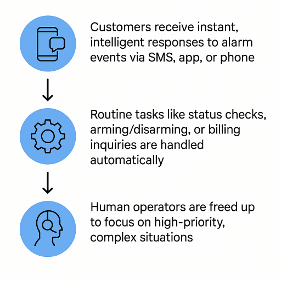
This shift not only enhances customer satisfaction but also drives operational efficiency at scale.
Several trends are accelerating this transformation:
- Cloud-native monitoring platforms enable flexible, scalable AI integrations
- Edge AI brings processing power closer to devices, reducing latency
- AI co-pilots for operators that assist with decision-making in real-time
- Hybrid human-machine workflows, combining automation speed with human judgment
Use cases are expanding too, from commercial buildings and smart cities to data centres, logistics hubs, and critical infrastructure.
What This Means for Monitoring Stations
In the next 3–5 years, we expect fewer but higher-quality alerts to monitor, more autonomous systems that require oversight, not micromanagement, a shift in operator roles from responders to supervisors and analysts and greater customer expectations for insight-rich, on-demand support.
This evolution is not optional; it’s strategic. The companies that prepare now will be the ones leading tomorrow.
How GeminiSense Is Preparing for the Future
At GeminiSense, we’re actively exploring and investing in AI and automation technologies designed to transform alarm monitoring. Our roadmap includes integrated anomaly detection and predictive maintenance modules. We’re testing machine learning models to improve event classification and reduce false positives, and our cloud-first architecture is built to support real-time AI inference and automation workflows.
We may not be “fully there” yet, but we’re thinking boldly, acting deliberately, and building for what’s next.
By aligning with these emerging capabilities, GeminiSense is not just keeping up – we’re helping define what modern security monitoring looks like.
Final Thoughts
The future of alarm monitoring is intelligent, responsive, and predictive. With AI and automation, security operations are no longer about what happened; they’re about what’s next.
If you’re ready to explore what the future can mean for your monitoring station, GeminiSense is here to help you lead with confidence. Let’s talk about tomorrow – today. Contact us below or email [email protected]




